09 September is PAO Awareness Day
PAO: Ask the experts Q&A
What causes PAO? Will bones recover? Is it safe to breastfeed or have another pregnancy? Our November 2025 expert Q&A answers the questions women living with Pregnancy Associated Osteoporosis ask most.
SUPPORTRESEARCH
1/8/20269 min read
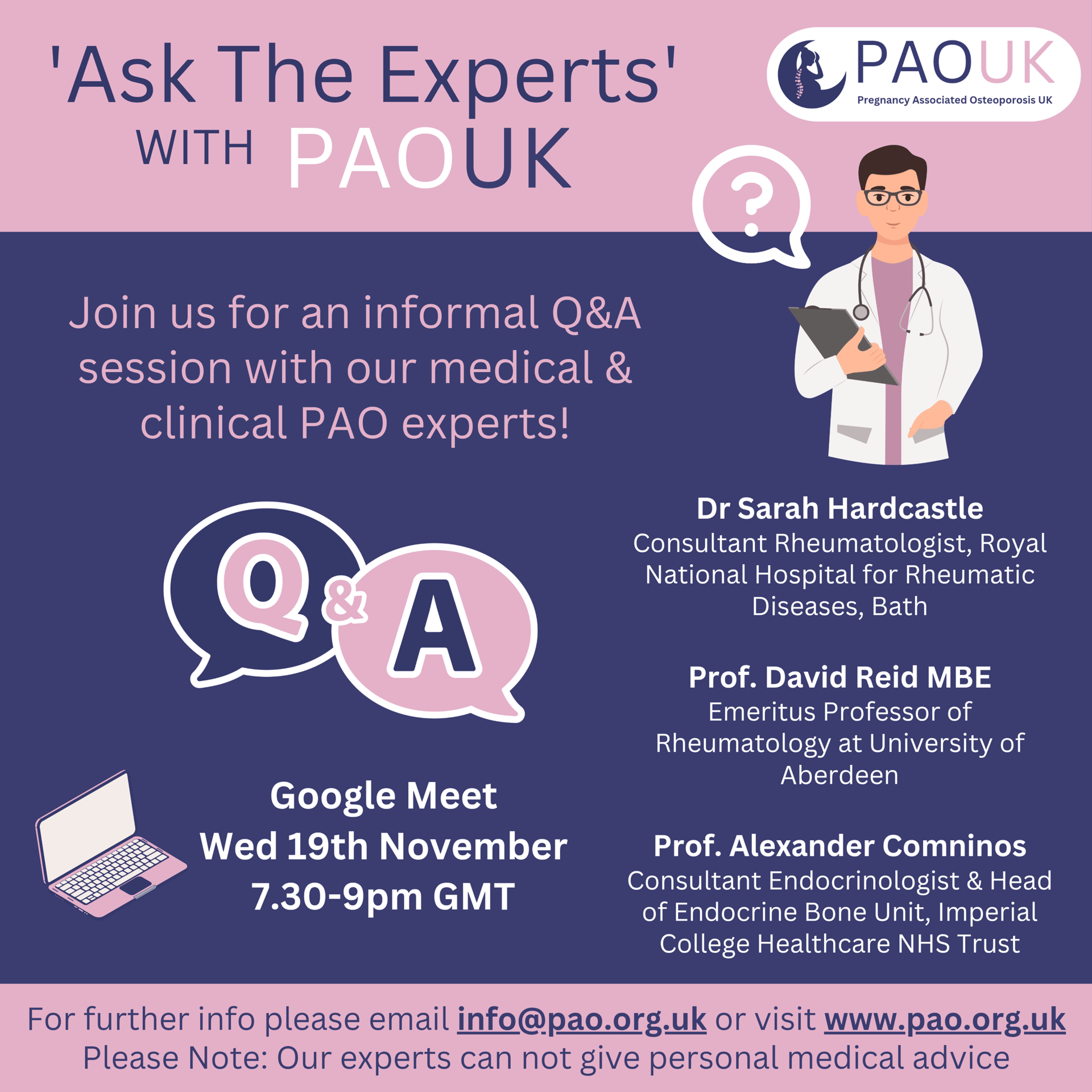
In November 2025, PAO UK hosted an online “Ask the experts” Q&A for people affected by Pregnancy Associated Osteoporosis (PAO), also known as Pregnancy and Lactation Associated Osteoporosis (PLO). It was a great turn out, with 26 women attending and over 45 questions received in advance, as well as plenty of further discussion during the session.
The panel brought together clinicians who work with pregnancy-related and premenopausal bone health:
Dr Sarah Harcastle (Consultant Rheumatologist, Royal National Hospital for Rheumatic Diseases, Bath)
Professor David Reid MBE (Emeritus Professor of Rheumatologist at University of Aberdeen)
Professor Alexander Comninos (Consultant Endocrinologist & Head of Imperial Endocrine Bone Unit, Imperial College Healthcare NHS Trust).
Q1. Does my baby need more calcium than a ‘normal’ baby? Is PAO caused by the baby ‘taking’ calcium?
Short answer: no. Babies do not have “extra” calcium needs. PAO is not caused by the baby being “hungrier” for calcium. It is more about how the mother’s body adapts (or struggles to adapt) to the increased calcium and mineral demands of pregnancy and breastfeeding, as well as other factors such as medical history.
Key points shared:
A newborn baby’s skeleton contains around 30 grams of calcium.
In late pregnancy (particularly the third trimester), a mother transfers significant calcium to the baby (figures discussed were around 300-350 mg/day at peak).
During breastfeeding, calcium transfer continues (around 200–250 mg/day at peak was discussed).
If someone enters pregnancy with lower bone density (even slightly), the additional bone loss that can occur in pregnancy and lactation may “drop” them below a threshold where fractures become more likely.
The body is biologically designed to prioritise calcium delivery to the baby, sometimes at the mother’s expense.
“This isn’t about the baby taking too much calcium. The baby’s needs are normal. It’s about the mother’s body being unable to adapt to the physiological demands of pregnancy and breastfeeding, as well as other factors.”
Q2. Is there a link between PAO and menopause-related osteoporosis?
The panel described this as an area where long-term evidence is limited, partly because PAO is rare and long follow-up studies are still emerging.
What they agreed on:
If bone density does not fully recover after PAO, someone may reach menopause starting from a lower baseline, which could increase the likelihood of meeting the “osteoporosis” threshold later (for example, a DXA T-score of less than -2.5).
If recovery is strong and bone density returns to a healthy range, risk later on may be closer to average, though individual factors such as genetics still matter.
A major unknown is that most people who develop PAO never had a bone density scan before pregnancy, so clinicians often don’t know the true starting point.
“One of the hardest things about PAO is that we don’t know where women are starting from, because most have never had a bone density scan before pregnancy.”
Q3. What do studies suggest about causes and risk factors for PAO/PLO?
The panel emphasised that there is no single confirmed cause – it is multifactorial. Most evidence comes from observational studies (comparing people with PAO/PLO to those who have been pregnant without developing it), which can identify associations but cannot often prove cause.
Potentially relevant factors discussed included:
Low BMI
Vitamin D deficiency
Low physical activity earlier in life
Family history of osteoporosis
History of eating disorder and/or prolonged low oestrogen states (for example, multiple missed periods during earlier life)
Possible genetic susceptibility in a subset of people (see below)
Mechanical and postural factors (for example petite frame, spinal curvature, pregnancy load, lifting).
The panel noted that other conditions known to increase osteoporosis risk (for example malabsorption conditions) may be relevant for some individuals, but strong conclusions are difficult due to limited numbers in studies.
“There is no single cause, no single pathway, and no one-size-fits-all answer in PAO.”
Q4. Do blood thinners or aspirin in pregnancy cause bone loss?
The discussion separated different medications:
Heparin (including prolonged courses in pregnancy): historically associated with bone loss in some cases, and continues to be discussed as a risk factor.
Warfarin: potential negative effect on bone has been identified; it acts through vitamin K pathways, which are also involved in bone biology.
Newer anticoagulants (often ending in “-ban”): the panel did not see convincing evidence of a major bone effect but noted that real-life prescribing is complicated by the medical reason someone needs anticoagulation.
Aspirin (low dose): the panel felt it was very unlikely to be a cause of significant bone loss in this context.
If you are on anticoagulants and worried about bone health, the panel strongly encouraged discussing your individual risks with clinicians from the relevant specialties (for example haematology and bone/endocrine specialists together), because clot prevention is critical.
Q5. Is PAO genetic? Are children (girls or boys) of PAO mums at risk?
The panel described genetics as a developing area. Key points:
Some studies suggest that a proportion of women with PLO/PAO may have genetic variants related to impaired bone remodelling, though not all variants necessarily cause clinical problems.
Rare conditions (for example osteogenesis imperfecta) can sometimes be “unmasked” by pregnancy and are often inherited but these cases often have additional clues (such as a history of multiple fractures earlier in life or family history).
Follow-up studies of children born to mothers with PAO/PLO (as discussed in this session) have so far not shown increased fractures in early childhood, though longer follow-up and larger studies are needed.
The panel highlighted ongoing UK research led by Professor Stuart Ralston, aiming to better understand genetics in PAO by comparing affected women with control groups.
Q6. REMS vs DEXA: which scan is best?
DEXA remains the standard for diagnosis.
The panel explained:
DEXA (dual-energy X-ray absorptiometry) measures bone mineral density and is the recognised clinical gold-standard.
REMS and other ultrasound-based techniques measure bone in a different way (using reflected sound waves). They have potential advantages (predominantly no radiation) and may be useful in research or monitoring trends during pregnancy but are not currently universally accepted as a diagnostic replacement for DEXA by international standard-setting bodies.
A cautious approach was recommended: REMS might be a helpful “flag” in some settings, but DEXA is still relied upon for diagnosis and clinical decisions.
Q7. What recovery can happen without medication, and when is treatment recommended?
The panel described this as one of the biggest clinical dilemmas in PAO.
Key themes:
Bone density can recover naturally after pregnancy and breastfeeding stop, often over 12–18 months.
Decisions about medication are individualised based on fracture number/severity, pain, scan results, and personal circumstances.
Some clinicians lean towards early treatment if someone has multiple vertebral fractures to reduce the chance of further fractures while recovery is happening.
They also noted a limitation: the evidence base is mainly observational (rather than large randomised trials) because PAO is rare and so robust trials are difficult to run.
“We are often making decisions in the absence of perfect evidence. That means listening carefully to the woman in front of us, not just the scan.”
Q8. Which drug treatments are licensed for PAO in England?
The panel stated that there are no osteoporosis drugs specifically licensed for PAO/PLO. Treatment, where used, is commonly off-label, as happens in many areas of medicine when the condition is rare.
They stressed that “not licensed for PAO” does not automatically mean “unsafe” or “inappropriate”. Licensing often reflects what drug companies have sought approval for (typically larger, more common populations which are economically sensible for the pharmaceutical company to seek approval for), rather than a definitive judgement on whether a drug can help an individual case.
A repeated message was that access and advice can vary, and it is important to be assessed by clinicians with bone expertise in premenopausal patients.
“Sometimes doing nothing is reasonable. Sometimes the circumstances and high risk of further fractures means we need to intervene.”
Q9. Is teriparatide still the recommended treatment?
The panel noted that there are currently no formal PAO treatment guidelines, and practice varies.
Several observational studies have shown marked improvements in bone density in PAO/PLO patients given Teriparatide, therefore it is the preferred option of some clinicians in severe cases. However it has not been compared with other treatment options in randomised trials, and will not be appropriate for everyone.
Abaloparatide is a newer medication with a similar mechanism of action to teriparatide. It is potentially promising but to date there is no published data regarding its use in PAO, and availability/access may vary.
Access to anabolic treatments can depend on local NHS funding pathways and may require an individual application for funding.
Q10. What about romosozumab in PAO?
Romosozumab is another anabolic drug with a different mechanism of action. The panel described it as an area to “watch”, with early positive signals but limited data in PAO/PLO.
Overall: not ruled out but the panel was clear that this remains evidence-limited for PAO and decisions should be specialist-led.
Q11. Zoledronate infusions vs teriparatide: which makes more sense?
A key explanation offered:
During pregnancy and lactation there is increased bone resorption (bone loss). After pregnancy and breastfeeding stop, the goal often becomes rebuilding bone.
Anabolic treatments (like teriparatide) directly support building bone and so may be preferred.
Zoledronate (a bisphosphonate) reduces bone resorption but stays in the skeleton for a long time, so potential implications for future pregnancy must be considered.
The panel acknowledged that clinical practice varies, and decisions depend on the individual’s risk, recovery, and future family plans.
Q12. Does stopping breastfeeding and periods returning help PAO recovery?
Yes. The panel stressed that the return of menstrual cycles signals recovery of oestrogen levels (which are low during breast-feeding), which supports bone stability and recovery.
They also noted that breastfeeding decisions are deeply personal and should be supported with balanced information about risks and benefits, including practical family considerations.
“Breastfeeding decisions after PAO are deeply personal. Our role is to give women the information, not to make the decision for them.”
Q13. Should breastfeeding be avoided in a later pregnancy after PAO?
The panel emphasised there is no one-size-fits-all rule. Advice should be individualised and informed by:
Bone density recovery before the next pregnancy
Severity of the original PAO episode
Personal values and feeding preferences
The option of compromise approaches (for example shorter breastfeeding, monitoring plans).
A shared message was: seek specialist input early, ideally before conceiving again.
“A second pregnancy after a PAO diagnosis is not the same as the first because now there is awareness, monitoring, and optimisation.”
Q14. Is there a DEXA score you should reach before trying for another pregnancy, and how long should you wait?
The panel did not give a single “safe” threshold. They highlighted:
Natural recovery after weaning commonly takes at least 12-18 months, sometimes longer.
Risk depends on the whole picture: fracture history, symptoms, scan trends (often using Z-scores in younger people), lifestyle factors, general health and any medications used.
A helpful clarification was raised: in younger people, clinicians often focus on Z-scores (comparison to age-matched norms like a standard age-matched reference range) rather than T-scores (comparison to peak bone mass typically of a 30 year old woman).
Q15. How reliable are DEXA scores in small-framed people? Do bone size and soft tissue affect results?
A participant asked a detailed question about how DEXA is influenced by bone size and body composition. The panel agreed DEXA is not a perfect 3D measure:
DXA is essentially a 2D, area-based measurement, so bone size can indeed affect readings (with smaller bones associated with underestimated areal bone density compared to larger bones with the same volumetric density)
Soft tissue composition can also influence results, and manufacturers use proprietary algorithms.
Despite limitations, DEXA remains the standard tool, and results should be interpreted within clinical context.
If you have very low scores, the panel advised continuing to take them seriously while also recognising the measurement limitations.
Q16. What do you wish more PAO patients were doing to improve bone health?
The panel reflected positively that people with PAO are often extremely informed and proactive. They highlighted:
Many patients arrive already taking calcium and vitamin D and engaging thoughtfully with lifestyle changes.
A wider public health gap is that bone health is not routinely emphasised in younger people and during the preconception period.
Safe, appropriate strengthening and posture work, especially back extensor strength after vertebral fractures, was specifically mentioned as important.
Microbiome research was also mentioned as an emerging area of interest in bone health.
Q17. Do you need follow-on medication after teriparatide? What about repeating teriparatide later?
When given to postmenopausal women and men, teriparatide (and other anabolic drugs) are usually followed by a course of antiresorptive treatment (typically an oral bisphosphonate, or zoledronate). The panel described follow-on therapy after anabolic treatment as evidence-limited in PAO.
One study discussed suggested that, in younger women, bone gains after teriparatide may be maintained without routine follow-on medication. In younger/premenopausal people, bone may be maintained more easily because of endogenous oestrogen and potentially better general health with a younger skeleton, but PAO-specific evidence is limited and therefore individual clinicians may take different approaches
On repeating courses:
Historically, teriparatide was limited to a single two-year lifetime course, based on early safety concerns (largely from animal data).
Experience and registry data have reduced concern, and clinical opinions are evolving, including occasional extended or repeated use in selected cases, led by specialists.
Q18. Contraception after PAO: what’s safest for bones?
This topic came up because return of natural cycles is important for bone recovery, yet contraception choices matter.
The panel shared general principles (not individual medical advice):
Oestrogen is protective for bone particularly when in a natural form such as oestradiol valerate (as in HRT preparations and some oral contraceptive preparations)
Some progesterone-only options may be less favourable for bone in certain contexts.
Combined (oestrogen-containing) methods may be preferable for bone health, depending on the individual’s risks and medical history.
This is an area where personal medical history matters (including clot risk), so the panel encouraged discussion with clinicians.
Q19. How can I see an expert?
The panel noted that PAO is recognised within UK specialist pathways, including the NHS UK adult rare bone disease network, which can help local teams to identify an appropriate referral centre. PAO UK can help with signposting if necessary.
“PAO patients are some of the most informed and engaged people we see in clinic.”
A final note
This Q&A highlighted how much is known about the physiology of pregnancy and lactation, and how much still needs better evidence in PAO specifically. The panel repeatedly encouraged:
Early specialist assessment for anyone with suspected or confirmed PAO
Individualised decision-making, particularly around medication and future pregnancies
Ongoing participation in research where possible, to build clearer guidance for the future.
“At the end of the day, this is your body, your family, and your life. Our job is to support you with evidence, honesty, and compassion.”
PAO UK thanks everyone who attended and shared questions, and the clinicians who contributed their time and expertise on 19 November 2025.